Review


hek293 tet off advanced cell line  (TaKaRa)


Bioz Verified Symbol TaKaRa is a verified supplier
Bioz Manufacturer Symbol TaKaRa manufactures this product  
  • Logo
  • About
  • News
  • Press Release
  • Team
  • Advisors
  • Partners
  • Contact
  • Bioz Stars
  • Bioz vStars
  • 94

    Structured Review

    TaKaRa hek293 tet off advanced cell line
    Hek293 Tet Off Advanced Cell Line, supplied by TaKaRa, used in various techniques. Bioz Stars score: 94/100, based on 207 PubMed citations. ZERO BIAS - scores, article reviews, protocol conditions and more
    https://www.bioz.com/result/hek293 tet off advanced cell line/product/TaKaRa
    Average 94 stars, based on 207 article reviews
    hek293 tet off advanced cell line - by Bioz Stars, 2026-03
    94/100 stars

    Images


    Similar Products

    94
    TaKaRa hek293 tet off advanced cell line
    Hek293 Tet Off Advanced Cell Line, supplied by TaKaRa, used in various techniques. Bioz Stars score: 94/100, based on 1 PubMed citations. ZERO BIAS - scores, article reviews, protocol conditions and more
    https://www.bioz.com/result/hek293 tet off advanced cell line/product/TaKaRa
    Average 94 stars, based on 1 article reviews
    hek293 tet off advanced cell line - by Bioz Stars, 2026-03
    94/100 stars
      Buy from Supplier

    94
    TaKaRa hek293 tet off cells
    Hek293 Tet Off Cells, supplied by TaKaRa, used in various techniques. Bioz Stars score: 94/100, based on 1 PubMed citations. ZERO BIAS - scores, article reviews, protocol conditions and more
    https://www.bioz.com/result/hek293 tet off cells/product/TaKaRa
    Average 94 stars, based on 1 article reviews
    hek293 tet off cells - by Bioz Stars, 2026-03
    94/100 stars
      Buy from Supplier

    94
    TaKaRa hek293 tet on advanced cells
    Hek293 Tet On Advanced Cells, supplied by TaKaRa, used in various techniques. Bioz Stars score: 94/100, based on 1 PubMed citations. ZERO BIAS - scores, article reviews, protocol conditions and more
    https://www.bioz.com/result/hek293 tet on advanced cells/product/TaKaRa
    Average 94 stars, based on 1 article reviews
    hek293 tet on advanced cells - by Bioz Stars, 2026-03
    94/100 stars
      Buy from Supplier

    94
    TaKaRa hek293 ptet off advanced cell line
    Figure 1. Establishment of the TET agonist screening system. (a) Inducible expression of the catalytic domain (CD) of TET1 was achieved by stable transfection of FLAG-HA (FH) tagged as TET1-CD in the pTRE-Tight vector into <t>HEK293</t> Tet-Off cells. FH-TET1-CD expression was triggered upon the
    Hek293 Ptet Off Advanced Cell Line, supplied by TaKaRa, used in various techniques. Bioz Stars score: 94/100, based on 1 PubMed citations. ZERO BIAS - scores, article reviews, protocol conditions and more
    https://www.bioz.com/result/hek293 ptet off advanced cell line/product/TaKaRa
    Average 94 stars, based on 1 article reviews
    hek293 ptet off advanced cell line - by Bioz Stars, 2026-03
    94/100 stars
      Buy from Supplier

    94
    TaKaRa hek293 cell lines
    Figure 1. Establishment of the TET agonist screening system. (a) Inducible expression of the catalytic domain (CD) of TET1 was achieved by stable transfection of FLAG-HA (FH) tagged as TET1-CD in the pTRE-Tight vector into <t>HEK293</t> Tet-Off cells. FH-TET1-CD expression was triggered upon the
    Hek293 Cell Lines, supplied by TaKaRa, used in various techniques. Bioz Stars score: 94/100, based on 1 PubMed citations. ZERO BIAS - scores, article reviews, protocol conditions and more
    https://www.bioz.com/result/hek293 cell lines/product/TaKaRa
    Average 94 stars, based on 1 article reviews
    hek293 cell lines - by Bioz Stars, 2026-03
    94/100 stars
      Buy from Supplier

    94
    TaKaRa tet on advanced hek293 cells
    Figure 1. Establishment of the TET agonist screening system. (a) Inducible expression of the catalytic domain (CD) of TET1 was achieved by stable transfection of FLAG-HA (FH) tagged as TET1-CD in the pTRE-Tight vector into <t>HEK293</t> Tet-Off cells. FH-TET1-CD expression was triggered upon the
    Tet On Advanced Hek293 Cells, supplied by TaKaRa, used in various techniques. Bioz Stars score: 94/100, based on 1 PubMed citations. ZERO BIAS - scores, article reviews, protocol conditions and more
    https://www.bioz.com/result/tet on advanced hek293 cells/product/TaKaRa
    Average 94 stars, based on 1 article reviews
    tet on advanced hek293 cells - by Bioz Stars, 2026-03
    94/100 stars
      Buy from Supplier

    94
    TaKaRa hek293 gp
    ( A ) HeLa CDC14B-YFP and HeLa YFP -inducible cell lines were grown in heavy and light medium, respectively, to compare the phospho-proteome by mass spectrometry (MS). m / z , mass/charge ratio; IMAC, immobilized metal affinity chromatography. ( B ) Molecular network of the hypophosphorylated proteins (hits) from (A). The network was constructed in Cytoscape to extract functional information and shows hits (bold font) and their most related genes (regular font) identified using a guilt-by-association approach. Coexpression and shared protein domains are denoted by purple and yellow lines, respectively. The identified phosphorylation sites are summarized in table S1. ( C ) Gene Ontology (GO) analysis of hypophosphorylated proteins from (B). FDR, false discovery rate. ( D ) Sequence logos of hypophosphorylated p-sites from (A). ( E ) RPE1 WT and RPE1 CDC14B KO cells were treated with 3.3 μM NOC for 24 hours to accumulate prometaphase cells with high MeCP2 pS92 signal. The MeCP2 pS92 /MeCP2 ratio was densitometrically measured and is depicted in the graph on the right-hand side of the immunoblot. The asterisk indicates nonspecific protein bands that are detected by the anti-MeCP2 pS92 antibody. Green lines depict position of specific bands. The quantification was performed on three independent experiments. ( F ) RPE1 Tet ON cells expressing CDC14B-mSc or the catalytic inactive CDC14B C314S -mSc were treated and analyzed as described in (E). Asterisk and lines as in (E). The quantification was performed on three independent experiments. a.u., arbitrary units. ( G ) In vitro dephosphorylation of MeCP2 pS92 by purified CDC14B. <t>HEK293T</t> cells were transfected with MeCP2-FLAG . MeCP2-FLAG protein was immunoprecipitated using FLAG beads and incubated with recombinant CDC14B-GFP or catalytic inactive CDC14B C314S -GFP in vitro. The MeCP2 pS92 /MeCP2 ratio was densitometrically measured and is depicted in the graph next to the immunoblot. The quantification was performed on three independent experiments. IP, immunoprecipitation. (E to G) Results are means ± SD. Two-tailed unpaired t test. n.s. (not significant) P > 0.05, ** P < 0.01, and **** P < 0.0001.
    Hek293 Gp, supplied by TaKaRa, used in various techniques. Bioz Stars score: 94/100, based on 1 PubMed citations. ZERO BIAS - scores, article reviews, protocol conditions and more
    https://www.bioz.com/result/hek293 gp/product/TaKaRa
    Average 94 stars, based on 1 article reviews
    hek293 gp - by Bioz Stars, 2026-03
    94/100 stars
      Buy from Supplier

    94
    TaKaRa hek293 cell line
    ( A ) HeLa CDC14B-YFP and HeLa YFP -inducible cell lines were grown in heavy and light medium, respectively, to compare the phospho-proteome by mass spectrometry (MS). m / z , mass/charge ratio; IMAC, immobilized metal affinity chromatography. ( B ) Molecular network of the hypophosphorylated proteins (hits) from (A). The network was constructed in Cytoscape to extract functional information and shows hits (bold font) and their most related genes (regular font) identified using a guilt-by-association approach. Coexpression and shared protein domains are denoted by purple and yellow lines, respectively. The identified phosphorylation sites are summarized in table S1. ( C ) Gene Ontology (GO) analysis of hypophosphorylated proteins from (B). FDR, false discovery rate. ( D ) Sequence logos of hypophosphorylated p-sites from (A). ( E ) RPE1 WT and RPE1 CDC14B KO cells were treated with 3.3 μM NOC for 24 hours to accumulate prometaphase cells with high MeCP2 pS92 signal. The MeCP2 pS92 /MeCP2 ratio was densitometrically measured and is depicted in the graph on the right-hand side of the immunoblot. The asterisk indicates nonspecific protein bands that are detected by the anti-MeCP2 pS92 antibody. Green lines depict position of specific bands. The quantification was performed on three independent experiments. ( F ) RPE1 Tet ON cells expressing CDC14B-mSc or the catalytic inactive CDC14B C314S -mSc were treated and analyzed as described in (E). Asterisk and lines as in (E). The quantification was performed on three independent experiments. a.u., arbitrary units. ( G ) In vitro dephosphorylation of MeCP2 pS92 by purified CDC14B. <t>HEK293T</t> cells were transfected with MeCP2-FLAG . MeCP2-FLAG protein was immunoprecipitated using FLAG beads and incubated with recombinant CDC14B-GFP or catalytic inactive CDC14B C314S -GFP in vitro. The MeCP2 pS92 /MeCP2 ratio was densitometrically measured and is depicted in the graph next to the immunoblot. The quantification was performed on three independent experiments. IP, immunoprecipitation. (E to G) Results are means ± SD. Two-tailed unpaired t test. n.s. (not significant) P > 0.05, ** P < 0.01, and **** P < 0.0001.
    Hek293 Cell Line, supplied by TaKaRa, used in various techniques. Bioz Stars score: 94/100, based on 1 PubMed citations. ZERO BIAS - scores, article reviews, protocol conditions and more
    https://www.bioz.com/result/hek293 cell line/product/TaKaRa
    Average 94 stars, based on 1 article reviews
    hek293 cell line - by Bioz Stars, 2026-03
    94/100 stars
      Buy from Supplier

    Image Search Results


    Figure 1. Establishment of the TET agonist screening system. (a) Inducible expression of the catalytic domain (CD) of TET1 was achieved by stable transfection of FLAG-HA (FH) tagged as TET1-CD in the pTRE-Tight vector into HEK293 Tet-Off cells. FH-TET1-CD expression was triggered upon the

    Journal: International journal of molecular sciences

    Article Title: Development of Novel Epigenetic Anti-Cancer Therapy Targeting TET Proteins.

    doi: 10.3390/ijms242216375

    Figure Lengend Snippet: Figure 1. Establishment of the TET agonist screening system. (a) Inducible expression of the catalytic domain (CD) of TET1 was achieved by stable transfection of FLAG-HA (FH) tagged as TET1-CD in the pTRE-Tight vector into HEK293 Tet-Off cells. FH-TET1-CD expression was triggered upon the

    Article Snippet: The HEK293 pTet-Off Advanced cell line (Clontech, Mountain View, CA, USA) was cotransfected with the pTRE-Tight-FH-TET1-CD and a Linear Puromycin Marker (Clontech).

    Techniques: Expressing, Stable Transfection, Plasmid Preparation

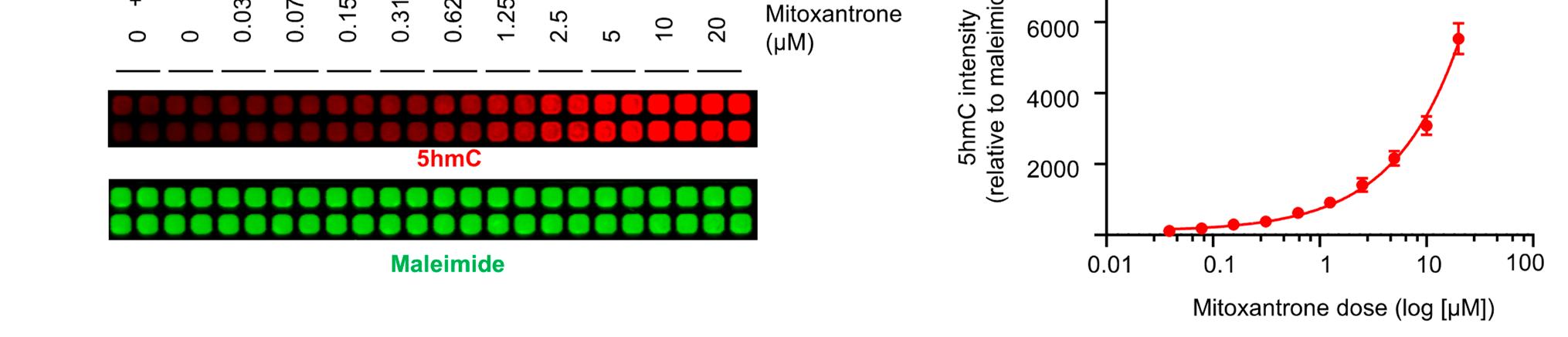
    Figure 2. Identification of mitoxantrone as a potential TET agonist through primary screening. (a) HEK#15 cells (4 × 10⁴ cells per well in 50 µL) cultured with (+) or without (−) Dox were seeded and maintained in a 384-well plate. After 2 days, the plate was co-stained with antibodies specific to HA (green) and 5hmC (red). Maleimide staining was used to monitor compound-induced cytotoxicity. (b,c) Levels of FH-TET1-CD protein and 5hmC in individual wells of the 384-well plate described in (a). Uniform staining intensities for TET1-CD and 5hmC within individual wells were observed. The Z’ factor values are also provided. Signal intensities were normalized to the mean of the maleimide staining intensities. (d) Summary of the results presented in (b,c). The mean ± s.d. is shown. (e) Molecular structure of NSC 279836, also known as mitoxantrone. (f) Dose-dependent elevation in 5hmC intensities in HEK15 cells upon mitoxantrone treatment. Maleimide staining was used to monitor compound-induced cytotoxicity. (g) Summary of the 5hmC signal intensities shown in (f). The 5hmC signal intensity was calculated by subtracting the mean of the vehicle-treated group from that of the drug-treated groups, which was then normalized to the mean of maleimide staining intensities. All data are presented as the mean ± s.d. The p-values were determined by unpaired Student’s t-test. **** p ≤0.0001.

    Journal: International journal of molecular sciences

    Article Title: Development of Novel Epigenetic Anti-Cancer Therapy Targeting TET Proteins.

    doi: 10.3390/ijms242216375

    Figure Lengend Snippet: Figure 2. Identification of mitoxantrone as a potential TET agonist through primary screening. (a) HEK#15 cells (4 × 10⁴ cells per well in 50 µL) cultured with (+) or without (−) Dox were seeded and maintained in a 384-well plate. After 2 days, the plate was co-stained with antibodies specific to HA (green) and 5hmC (red). Maleimide staining was used to monitor compound-induced cytotoxicity. (b,c) Levels of FH-TET1-CD protein and 5hmC in individual wells of the 384-well plate described in (a). Uniform staining intensities for TET1-CD and 5hmC within individual wells were observed. The Z’ factor values are also provided. Signal intensities were normalized to the mean of the maleimide staining intensities. (d) Summary of the results presented in (b,c). The mean ± s.d. is shown. (e) Molecular structure of NSC 279836, also known as mitoxantrone. (f) Dose-dependent elevation in 5hmC intensities in HEK15 cells upon mitoxantrone treatment. Maleimide staining was used to monitor compound-induced cytotoxicity. (g) Summary of the 5hmC signal intensities shown in (f). The 5hmC signal intensity was calculated by subtracting the mean of the vehicle-treated group from that of the drug-treated groups, which was then normalized to the mean of maleimide staining intensities. All data are presented as the mean ± s.d. The p-values were determined by unpaired Student’s t-test. **** p ≤0.0001.

    Article Snippet: The HEK293 pTet-Off Advanced cell line (Clontech, Mountain View, CA, USA) was cotransfected with the pTRE-Tight-FH-TET1-CD and a Linear Puromycin Marker (Clontech).

    Techniques: Cell Culture, Staining

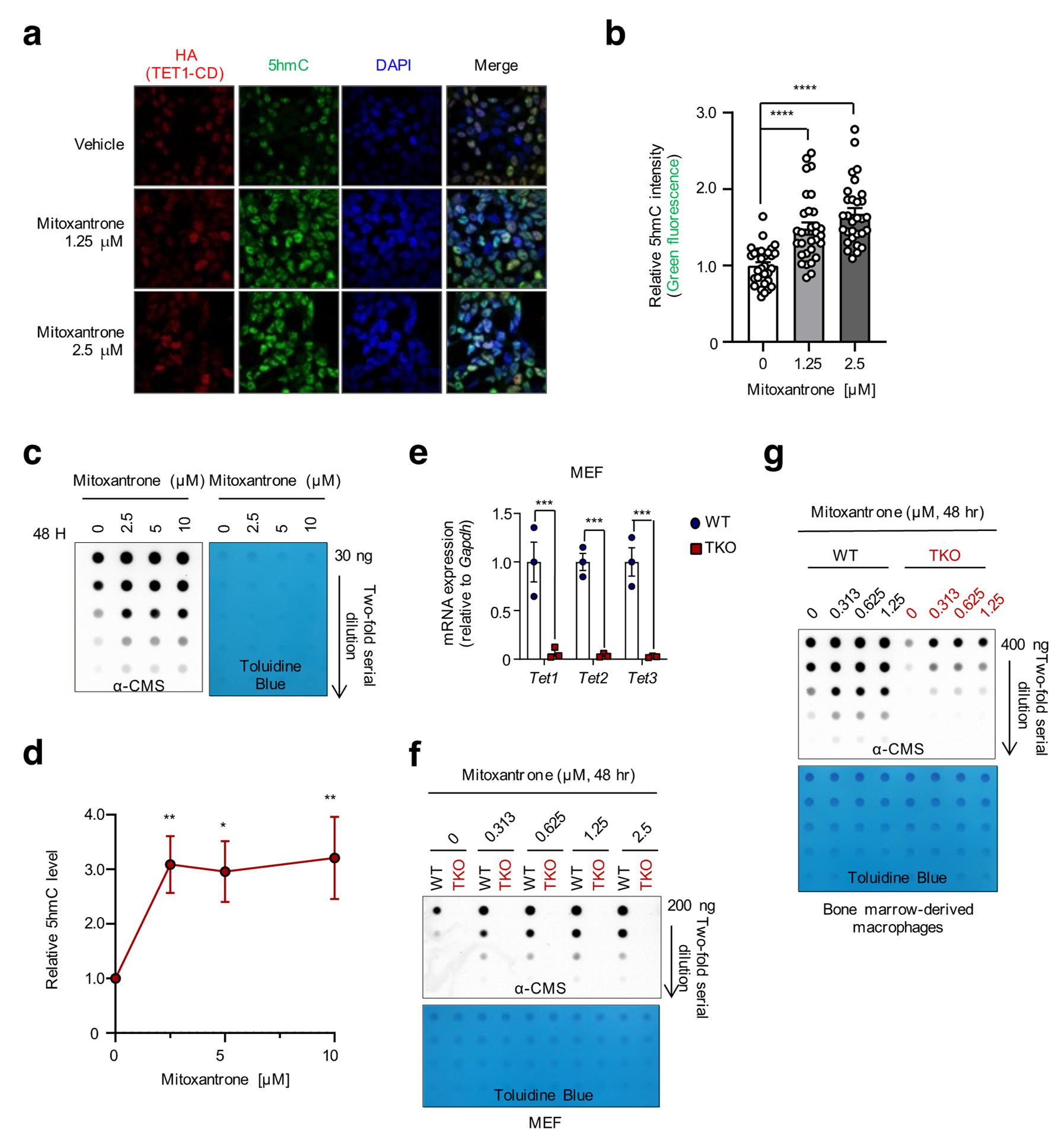
    Figure 3. Mitoxantrone augments 5hmC levels in a TET-dependent manner. (a) Immunocytochem- istry revealed the mitoxantrone-induced increase in 5hmC levels. HEK#15 cells, cultured without Dox, were treated with mitoxantrone at the indicated concentration and co-stained with antibodies specific for the HA epitope (red) and 5hmC (green). DAPI (blue) indicated nuclear staining. (b) Quantification of 5hmC intensities shown in (a). (c) Genomic DNA purified from HEK#15 cells treated with mitox- antrone as indicated was treated with bisulfite to convert 5hmC to cytosine 5-methylenesulfonate (CMS). CMS was quantified by dot blot assay using an anti-CMS antibody. Toluidine blue staining was used to monitor equivalent DNA loading. (d) Summary of the 5hmC intensities shown in (c). (e) Quantitative RT-PCR was performed to assess the levels of Tet1, Tet2, and Tet3 mRNAs relative to Gapdh in WT and TET triple knockout (TKO) MEFs (n = 3). (f,g) WT and TET TKO MEFs (f) or BMMs (f) were treated with increasing concentrations of mitoxantrone for 48 h, followed by quantification of 5hmC by anti-CMS dot blot. Toluidine blue staining was used to monitor equivalent DNA loading. All data are presented as the mean ± s.d. The p-values were determined by unpaired Student’s t-test. * p ≤0.05, ** p ≤0.01, *** p ≤0.001, and **** p ≤0.0001.

    Journal: International journal of molecular sciences

    Article Title: Development of Novel Epigenetic Anti-Cancer Therapy Targeting TET Proteins.

    doi: 10.3390/ijms242216375

    Figure Lengend Snippet: Figure 3. Mitoxantrone augments 5hmC levels in a TET-dependent manner. (a) Immunocytochem- istry revealed the mitoxantrone-induced increase in 5hmC levels. HEK#15 cells, cultured without Dox, were treated with mitoxantrone at the indicated concentration and co-stained with antibodies specific for the HA epitope (red) and 5hmC (green). DAPI (blue) indicated nuclear staining. (b) Quantification of 5hmC intensities shown in (a). (c) Genomic DNA purified from HEK#15 cells treated with mitox- antrone as indicated was treated with bisulfite to convert 5hmC to cytosine 5-methylenesulfonate (CMS). CMS was quantified by dot blot assay using an anti-CMS antibody. Toluidine blue staining was used to monitor equivalent DNA loading. (d) Summary of the 5hmC intensities shown in (c). (e) Quantitative RT-PCR was performed to assess the levels of Tet1, Tet2, and Tet3 mRNAs relative to Gapdh in WT and TET triple knockout (TKO) MEFs (n = 3). (f,g) WT and TET TKO MEFs (f) or BMMs (f) were treated with increasing concentrations of mitoxantrone for 48 h, followed by quantification of 5hmC by anti-CMS dot blot. Toluidine blue staining was used to monitor equivalent DNA loading. All data are presented as the mean ± s.d. The p-values were determined by unpaired Student’s t-test. * p ≤0.05, ** p ≤0.01, *** p ≤0.001, and **** p ≤0.0001.

    Article Snippet: The HEK293 pTet-Off Advanced cell line (Clontech, Mountain View, CA, USA) was cotransfected with the pTRE-Tight-FH-TET1-CD and a Linear Puromycin Marker (Clontech).

    Techniques: Cell Culture, Concentration Assay, Staining, Dot Blot, Quantitative RT-PCR, Triple Knockout

    ( A ) HeLa CDC14B-YFP and HeLa YFP -inducible cell lines were grown in heavy and light medium, respectively, to compare the phospho-proteome by mass spectrometry (MS). m / z , mass/charge ratio; IMAC, immobilized metal affinity chromatography. ( B ) Molecular network of the hypophosphorylated proteins (hits) from (A). The network was constructed in Cytoscape to extract functional information and shows hits (bold font) and their most related genes (regular font) identified using a guilt-by-association approach. Coexpression and shared protein domains are denoted by purple and yellow lines, respectively. The identified phosphorylation sites are summarized in table S1. ( C ) Gene Ontology (GO) analysis of hypophosphorylated proteins from (B). FDR, false discovery rate. ( D ) Sequence logos of hypophosphorylated p-sites from (A). ( E ) RPE1 WT and RPE1 CDC14B KO cells were treated with 3.3 μM NOC for 24 hours to accumulate prometaphase cells with high MeCP2 pS92 signal. The MeCP2 pS92 /MeCP2 ratio was densitometrically measured and is depicted in the graph on the right-hand side of the immunoblot. The asterisk indicates nonspecific protein bands that are detected by the anti-MeCP2 pS92 antibody. Green lines depict position of specific bands. The quantification was performed on three independent experiments. ( F ) RPE1 Tet ON cells expressing CDC14B-mSc or the catalytic inactive CDC14B C314S -mSc were treated and analyzed as described in (E). Asterisk and lines as in (E). The quantification was performed on three independent experiments. a.u., arbitrary units. ( G ) In vitro dephosphorylation of MeCP2 pS92 by purified CDC14B. HEK293T cells were transfected with MeCP2-FLAG . MeCP2-FLAG protein was immunoprecipitated using FLAG beads and incubated with recombinant CDC14B-GFP or catalytic inactive CDC14B C314S -GFP in vitro. The MeCP2 pS92 /MeCP2 ratio was densitometrically measured and is depicted in the graph next to the immunoblot. The quantification was performed on three independent experiments. IP, immunoprecipitation. (E to G) Results are means ± SD. Two-tailed unpaired t test. n.s. (not significant) P > 0.05, ** P < 0.01, and **** P < 0.0001.

    Journal: Science Advances

    Article Title: The HIPK2/CDC14B-MeCP2 axis enhances the spindle assembly checkpoint block by promoting cyclin B translation

    doi: 10.1126/sciadv.add6982

    Figure Lengend Snippet: ( A ) HeLa CDC14B-YFP and HeLa YFP -inducible cell lines were grown in heavy and light medium, respectively, to compare the phospho-proteome by mass spectrometry (MS). m / z , mass/charge ratio; IMAC, immobilized metal affinity chromatography. ( B ) Molecular network of the hypophosphorylated proteins (hits) from (A). The network was constructed in Cytoscape to extract functional information and shows hits (bold font) and their most related genes (regular font) identified using a guilt-by-association approach. Coexpression and shared protein domains are denoted by purple and yellow lines, respectively. The identified phosphorylation sites are summarized in table S1. ( C ) Gene Ontology (GO) analysis of hypophosphorylated proteins from (B). FDR, false discovery rate. ( D ) Sequence logos of hypophosphorylated p-sites from (A). ( E ) RPE1 WT and RPE1 CDC14B KO cells were treated with 3.3 μM NOC for 24 hours to accumulate prometaphase cells with high MeCP2 pS92 signal. The MeCP2 pS92 /MeCP2 ratio was densitometrically measured and is depicted in the graph on the right-hand side of the immunoblot. The asterisk indicates nonspecific protein bands that are detected by the anti-MeCP2 pS92 antibody. Green lines depict position of specific bands. The quantification was performed on three independent experiments. ( F ) RPE1 Tet ON cells expressing CDC14B-mSc or the catalytic inactive CDC14B C314S -mSc were treated and analyzed as described in (E). Asterisk and lines as in (E). The quantification was performed on three independent experiments. a.u., arbitrary units. ( G ) In vitro dephosphorylation of MeCP2 pS92 by purified CDC14B. HEK293T cells were transfected with MeCP2-FLAG . MeCP2-FLAG protein was immunoprecipitated using FLAG beads and incubated with recombinant CDC14B-GFP or catalytic inactive CDC14B C314S -GFP in vitro. The MeCP2 pS92 /MeCP2 ratio was densitometrically measured and is depicted in the graph next to the immunoblot. The quantification was performed on three independent experiments. IP, immunoprecipitation. (E to G) Results are means ± SD. Two-tailed unpaired t test. n.s. (not significant) P > 0.05, ** P < 0.01, and **** P < 0.0001.

    Article Snippet: RPE1, human embryonic kidney (HEK) 293T, and HEK293-GP (GP2-293, Clontech) cells were cultured in Gibco Dulbecco’s Modified Eagle’s medium (DMEM)/F-12 (Thermo Fisher Scientific) medium supplemented with 10% fetal bovine serum (FBS), 1% l -glutamine, and 1% penicillin/streptomycin.

    Techniques: Mass Spectrometry, Affinity Chromatography, Construct, Functional Assay, Sequencing, Western Blot, Expressing, In Vitro, De-Phosphorylation Assay, Purification, Transfection, Immunoprecipitation, Incubation, Recombinant, Two Tailed Test